The Cyanotype process was originally developed by John Frederick Herschel. Herschel was originally a astronomer just trying to take simple notes when he came across this process. Anna Atkins was the first person to ever put this process to use in 1843. The Cyanotypes produced were featured in a book called ‘British Algae: Cyanotype impressions’. The book took 10 years to complete capturing British nature.
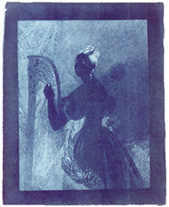
The Cyanotype Process-
What is needed-
- Two glass beakers
- Paint brush to apply the chemicals over the paper
- Amber bottle which stores the chemicals
- Timer
- thermometer
- Daylight in order to expose the paper
- Watercolour paper
- digital objective
- Clear glass bigger than the negative
- tray
- rubber gloves for safety
The Process-
- Mix the chemicals – 4 grams Potassium Ferricyanide, 10 grams Ferric Ammonium Citrate
- Then mix 50ml water to each chemical and mix until the particles dissolve
- Mix both chemicals equally
- Then prepare the canvas by applying an even coat of the chemical over the top and letting it dry as it will go darker.
- Then expose the picture by putting it under sunlight
- The last step is washing the canvas until it’s exposed.
My Attempt at doing the Cyanotype Process-


- Firstly, I needed my negative image so I used a photograph I had previously taken in Rome and imported it onto photoshop so I could digitally change it to a negative. To do this I clicked onto ‘image’ and chose ‘adjustments’ then ‘invert’.


I then printed the image onto tracing paper and place it onto the canvas which should be covered in the appropriate chemicals.
3. The tracing paper on the canvas was then placed into the exposure unit which has UV light inside. The image is inside the exposure unit for roughly 6 minutes.
4. After the image has finished exposing in the exposure unit, the photograph is then washed making sure all of the chemical has come off ( the chemical being a green colour on the photograph)
5. The image was then left to dry.
In my opinion, my photograph made from the Cyanotype process was successful as the detail is clearly shown. You can also see a clear contrast in the image of where the lighter and darker places would’ve been in the original image.
Health and Safety-
- The area used for making these prints needs to be clean and tidy to ensure that there are no tripping or falling over hazards.
- Make sure that you wear gloves when covering the canvas in the chemicals to protect your hands.
 Unit-21 FILM BASED PHOTOGRAPHY